Excerpted from a contribution by Professor Hung-Shing Chen, Graduate Institute of Electro-Optical Engineering, National Taiwan University of Science and Technology, to Science Monthly, March 2026
E-paper (electronic paper) is currently the display technology that most closely replicates the appearance of real paper, while also offering the dual advantages of being eye-friendly and energy-efficient. The two most promising color e-paper technologies are microcup electrophoretic ink (developed by E Ink) and Cholesteric Liquid Crystal Display (ChLCD). How do these two technologies differ in reproducing color? And which type of e-paper comes closer to the color quality of printed materials?
E-paper: a clever fusion of printing and displays
E-paper is the display technology that most closely approximates the look and feel of real paper. It offers two major advantages: eye protection and energy savings, along with the potential for flexibility and a paper-like display experience. Its display principle resembles that of conventional printed materials — light from an external source reflects off the display surface and enters the viewer’s eyes, rather than being emitted directly. Compared with traditional self-luminous displays, e-paper causes far less eye fatigue even during long viewing sessions. Furthermore, e-paper possesses a bistable characteristic, meaning it only consumes power when the displayed image changes, making it significantly more energy-efficient than traditional self-luminous displays. In short, e-paper combines the advantages of both conventional displays and printed paper: it can update its content at any time while retaining the visual and reading experience of real paper.
Microcup electrophoretic ink and ChLCD are the two most promising color e-paper technologies at present. The following section provides a brief introduction to each. To effectively analyze the colors of e-paper, this article uses the ICC color profile format defined by the International Color Consortium (ICC) to visualize and analyze the color gamut characteristics and luminance contrast of color e-paper.
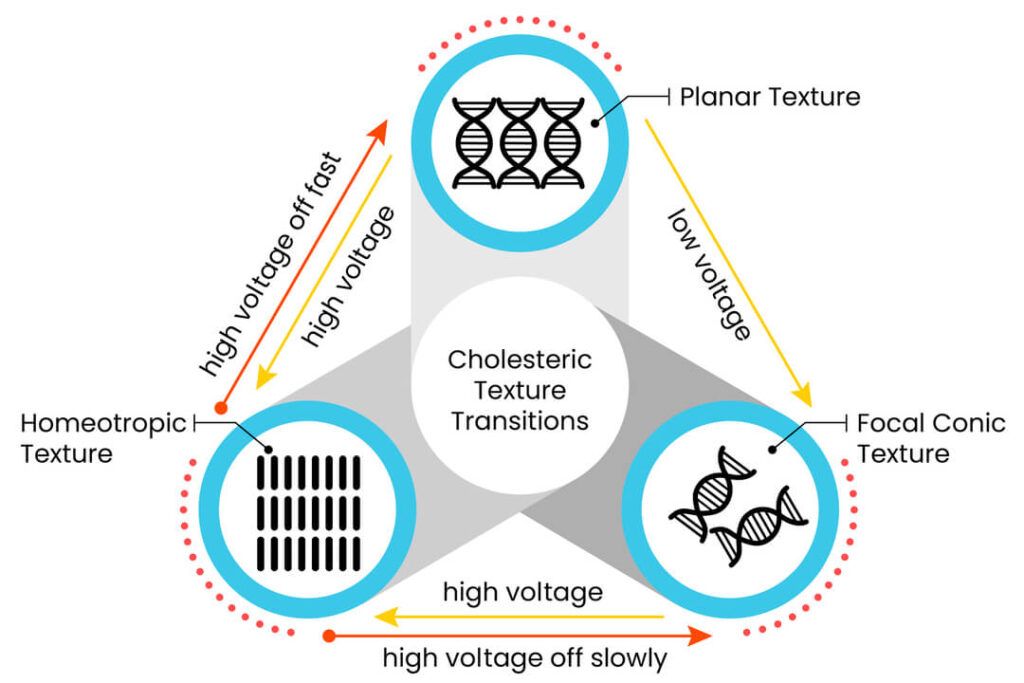
The leading manufacturer of ChLCD is IRIS Optronics. In this type of e-paper, cholesteric liquid crystal molecules inside the panel are driven by an electric field that adjusts the opening and closing angle of the liquid crystal layers to display images. The display is composed of three stacked cholesteric liquid crystal layers, each capable of reflecting one of the three primary colors: Red (R), Green (G), and Blue (B). By varying the strength of the electric field, the liquid crystal molecules within each layer are made to rotate. Even after the electric field is turned off, the liquid crystal molecules remain in one of two stable states, enabling bistability.

Figure (a) illustrates the color mixing principle of the ChLCD display. The panel uses three liquid crystal layers of red, green, and blue, plus a black absorption layer at the bottom. By adjusting the pitch of the liquid crystal molecules, different intensities of green, red, and blue light are reflected, achieving color mixing on the display.
The microcup electrophoretic ink technology is developed by E Ink Corporation. Currently released products include Gallery and Spectra 6. Gallery works by placing four types of ink particles — Cyan, Magenta, Yellow, and White (CMYW) — inside microscopic “microcups” within the e-paper. Spectra 6, on the other hand, uses Red, Blue, Yellow, and White (RBYW) particles inside the microcups. The microcup structure confines the ink particles within individual cells; by applying different voltages, the charged particles are driven to move within the microcups, and color mixing is then calculated algorithmically to produce full-color displays.

Figure (b) illustrates the color mixing principle of microcup electrophoretic ink (Gallery CMYW four-color system). The panel uses cyan (C), magenta (M), yellow (Y), and white (W) color particles placed inside microcups. The mixing process is analogous to traditional offset printing: colorants are first stacked (subtractive color mixing), and then juxtaposed like printing halftone dots (additive color mixing).
"Additive" mixing refers to predicting the resulting energy when colored lights are combined, using additive arithmetic. In the additive color model, the three primary colors are Red, Green, and Blue — expressed in the form of light (color light).

"Subtractive" mixing refers to the process whereby a colorant, when illuminated by white light, absorbs certain components of that light. In the subtractive color model for pigments, the three primary colors are Cyan, Magenta, and Yellow — expressed in the form of colorants.
Analyzing color performance of e-paper
ICC color profiles were created for three types of e-paper (IRIS ChLCD, E Ink Spectra 6, and E Ink Gallery) to visualize their 2D and 3D color gamuts, and to analyze whether their color reproduction approaches current print quality. The print standards used for comparison are the ICC color profile specifications for “Newspaper” and “Web Coated” paper media, as defined by the Japan Printing Machinery Association (JPMA). While 2D color gamut is more commonly used to analyze the color range of imaging media, 3D color gamut adds the dimension of lightness or luminance, providing a more accurate assessment and enabling a deeper understanding of the lightness, brightness, and contrast characteristics of color e-paper.

Figure (d) shows the 2D color gamut comparison of the three color e-paper types (ChLCD, Spectra 6, Gallery) in the CIE u'v' uniform chromaticity diagram. The results show that Gallery has the smallest color gamut among the three. ChLCD outperforms Spectra 6 in color saturation in the green and blue regions, while Spectra 6 has a slight advantage in the red region. When further compared with the newspaper print media color range, both ChLCD and Spectra 6 exceed the color gamut of newspaper media (except in the cyan saturation region), but remain smaller than that of Web Coated printing. This indicates that both technologies still have significant room for improvement in color reproduction quality when compared with general color printing.

Figure (e) shows the 3D color gamut analysis of ChLCD and Spectra 6 in the CIE LAB color space. Under the same standard daylight illumination conditions, ChLCD’s color gamut volume is 36% larger than that of Spectra 6, indicating broader color coverage. Regarding contrast, Spectra 6 achieves a contrast ratio of 26:1 while ChLCD achieves 10:1 — a difference of approximately 2.6 times. Compared with current color printing standards, both e-paper types still fall short in contrast performance.
Color e-paper carries the aspirations and dreams of many for the future of displays. It is widely regarded as a next-generation display technology and paper-like new medium that has attracted significant attention in recent years, with rapidly growing applications in e-readers, electronic blackboards, electronic shelf labels, and digital signage. It is believed that in the near future, color e-paper will continue to advance toward larger sizes, higher color saturation, and improved contrast ratios.
If you would like to know more about color e-paper applications, please get in touch with us.